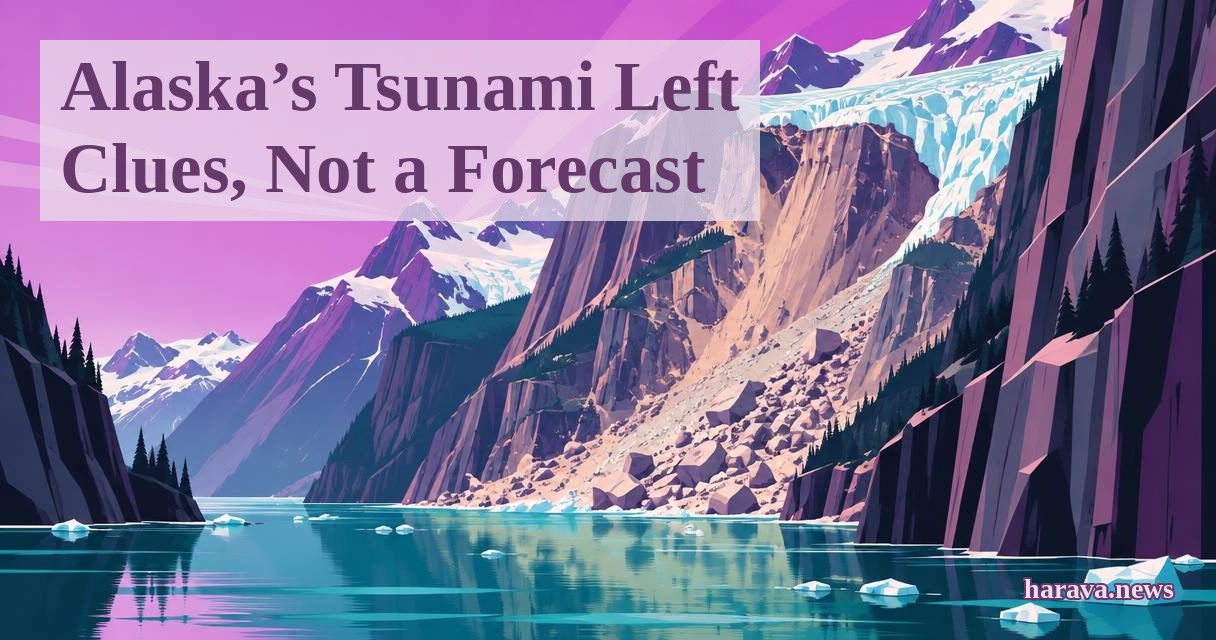
The 1,580-foot run-up at Alaska’s Tracy Arm in August 2025 exposed a dangerous gap between recognizing a landslide’s warning signs after the fact and predicting a tsunami in time to move people.
A massive surge in a narrow fjord
The run-up measures how high water climbed above sea level on the opposite wall, not the height of an open wave. A rock wedge collapsed and sent over 64 million cubic metres of debris into the fjord. The fall created an initial wave about 100 metres high. The narrow fjord channelled the surge, producing the second highest run-up on record.
Melting ice and rainfall
The mountainside lost support before the collapse. South Sawyer Glacier retreated more than a third of a mile in two months, uncovering the foot of the slope. When glacier ice pulls back, the rock it braced can become unstable. A study in Science called this retreat a precondition for the failure.
Water may have added pressure. Researchers Michael West and Ezgi Karasözen noted heavy rain, explaining that water in cracks can push a weakened slope toward failure. A NASA review described the rain as moderate. Together, the evidence suggests several conditions weakened the slope.
Hidden underground signals
Scientists detected thousands of small tremors before the slide, with activity increasing up to an hour before failure. However, these signals were identified only after the disaster. The landslide itself generated seismic waves equal to a magnitude 5.4 earthquake, but there were no prior public warnings.
Satellite images showed no cracks or slope movement before the failure. In addition, Alaska seismometers constantly record earthquakes, calving ice and rockfalls. Separating warning signals from everyday noise remains a difficult technical problem.
The challenge of future alerts
A disaster was avoided because of timing. The slide happened at 5:26 a.m., before cruise ships and tour boats reached the upper fjord. Afterward, several cruise lines changed their 2026 routes. The U.S. Geological Survey warned that further rockfalls could still generate waves.
A reliable early-warning system does not yet exist. The Alaska Earthquake Center is testing an algorithm across 200 seismic stations, but building an alert system could take years. Remote coastlines, limited funds and the need to deliver warnings quickly leave early detection an unsolved problem.