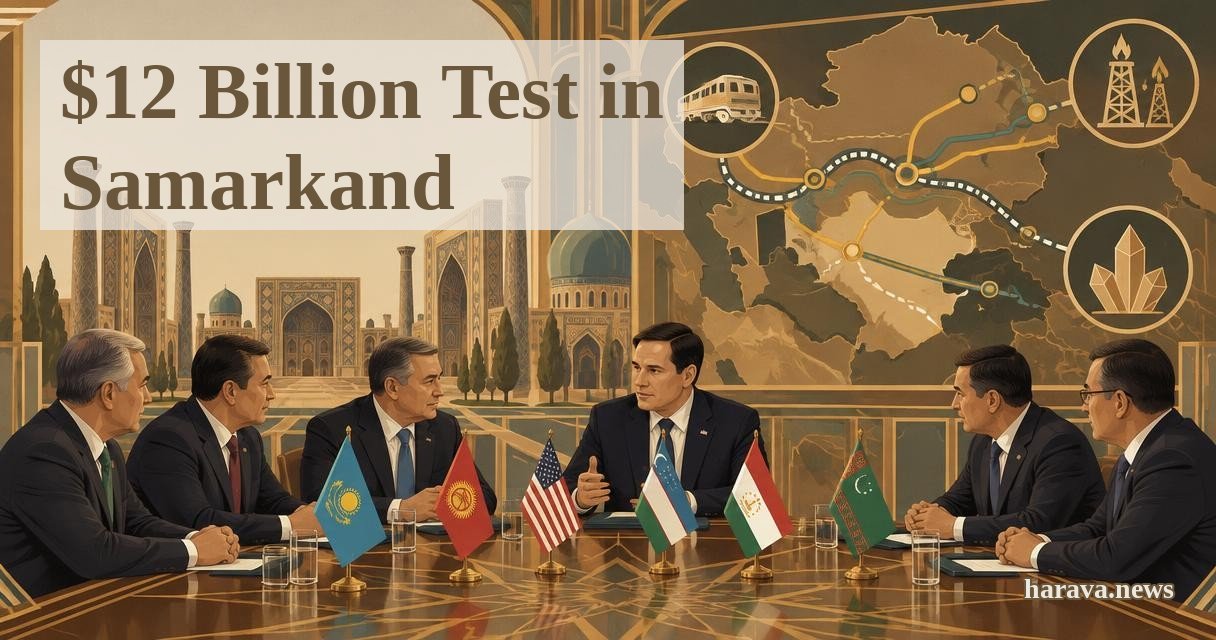
On Oct. 19, Marco Rubio met Central Asia’s five foreign ministers in Samarkand, where Uzbekistan announced $12 billion in agreements with U.S. partners.
A push for more options
The C5+1 forum began in 2015, and Samarkand hosted its first ministerial meeting. At this year’s meeting, the six governments called the United States and Central Asia long-term “partners of choice” and backed closer economic ties, transport links and cooperation on energy, minerals and technology. These are broad goals, not a funded regional plan.
Central Asian governments want more options for reaching outside markets. The region has no direct sea access, and Russia has long been a major trade route. Russia’s war in Ukraine sharpened concerns about relying heavily on one route. China’s trade with Central Asia exceeded $106 billion in 2025, while Uzbekistan’s trade with China approached $18 billion. U.S.-Uzbekistan trade in goods and services was about $1.7 billion. The figures are not directly comparable, but they show the scale of the gap.
Uzbekistan is pursuing ties with multiple powers, not simply switching from one partner to another. A stronger Trans-Caspian route could give exporters another path to global markets, while processing natural resources could help countries earn more from them. The joint statement emphasized transport links and production, not a choice between Washington and Beijing.
What the agreements include
Washington wants access to critical minerals, more diverse supply chains and opportunities for American companies. Rubio described the approach as competing for a fair chance to do business, not asking Central Asian governments to cut ties with other countries. He pointed to a delegation of nearly 300 businesses as a sign that the relationship should lead to commercial activity, not just official meetings.
Uzbekistan’s investment ministry reported 54 agreements in transport, energy, critical minerals, finance, digital technology, agriculture, health care and education. But it did not say how much of the $12 billion has financing or remains at the proposal or planning stage. The figure is an announced package, not proof that the money has been invested or is ready to spend.
Some plans involve Wabtec and local railway-equipment production; others concern mineral exploration and supply, satellite communications, medical technology and agricultural efficiency. Uzbekistan also signed the U.S.-led Artemis Accords on peaceful space exploration and launched a bilateral strategic dialogue. The visit went beyond a meeting, but the projects’ value depends on whether they reach financing, construction and operation.
The test is implementation
For Uzbekistan, the stakes include jobs, infrastructure and its credibility as a destination for foreign investment. President Shavkat Mirziyoyev has acknowledged that investors need a more predictable, transparent business environment. The other four Central Asian states raised shared priorities, but public announcements were concentrated in Uzbekistan. Reports on their bilateral talks described follow-up discussions rather than comparable deal packages. Regional governments have welcomed U.S. attention while signaling that commitments must lead to concrete investment.
Uzbek officials said an action plan would be developed for the agreements. Investors and governments will need to clarify project timelines, financing and responsibilities. The broader C5+1 agenda will also need specific steps on transport and regional trade. Until then, the $12 billion is an opening bid for a deeper relationship, not a measure of influence already secured.