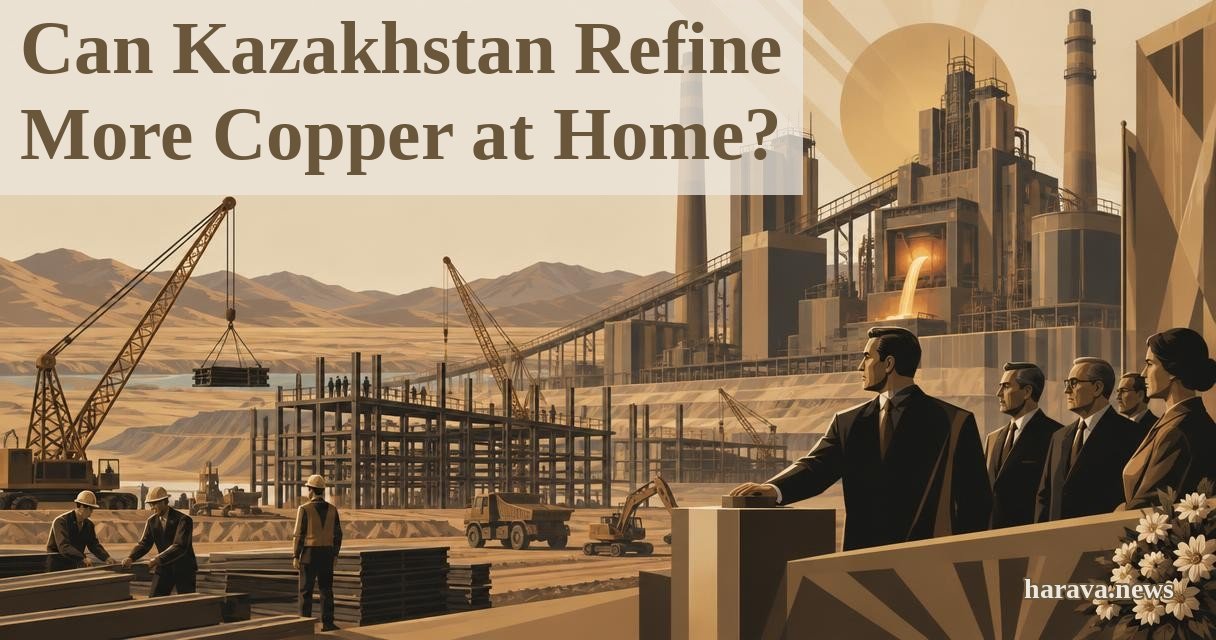
Kazakhstan has begun building a $1.8 billion copper smelter near Aktogay, with first production planned for 2030.
What the plant will do
KAZ Minerals is developing the facility, with China’s NFC as engineering partner. The plant is designed to produce 300,000 tonnes of cathode copper a year, as well as gold, silver and sulfuric acid. President Kassym-Jomart Tokayev led the launch ceremony, but the plant still must be built, equipped and commissioned.
The project aims to process more copper concentrate in Kazakhstan. KAZ Minerals’ chief executive said in June that the company exports concentrate and intends to process its own material at home. The original agreement named feedstock from the company’s Aktogay and Bozshakol operations. NFC was assigned design and equipment procurement, while NFC Kazakhstan was to handle construction and commissioning.
The limits of domestic processing
Tokayev has presented the smelter as a way to strengthen domestic metallurgy and make better use of national resources. But cathode copper is not wire, cable or machinery. The plant could keep more smelting and refining work in Kazakhstan without creating a large downstream manufacturing industry by itself.
Kazakhstan produced 471,000 tonnes of refined copper in 2025 and exported 400,800 tonnes in the first 11 months of that year. Tokayev says the new plant’s capacity will fully meet domestic needs, but the launch announcement gives no separate figure for demand. The 300,000-tonne capacity is a design target, not a guarantee of production or a measure of how much local manufacturers will buy.
Costs and deadlines have shifted
When the construction agreement was announced in June 2024, the preliminary cost was $1.5 billion and commissioning was scheduled by the end of 2028. In June 2026, KAZ Minerals’ chief executive put the start of production at 2030–2031. The October launch announcement gives the current target as 2030 and estimates investment at about $1.8 billion.
The public statements cited in the article do not explain the cost change or specify a financing package. NFC’s engineering and construction role does not mean it has committed to finance the project. The launch materials also leave questions about utilities, including power arrangements.
Construction is the next test
The project now needs engineering and equipment work, construction, recruitment, testing and commissioning. A 2024 government announcement said the smelting technology would meet international environmental standards. Current launch materials stress worker safety and meeting the schedule. More than 1,000 jobs are expected, as is the first cathode in 2030.
Global forecasts point in different directions. The International Copper Study Group forecasts a refined-copper surplus of 104,000 tonnes in 2026 and 368,000 tonnes in 2027. The IEA says existing and announced mine projects could leave copper supply about 25% short of demand by 2035. These forecasts cover different periods and parts of the supply chain. A smelter adds refining capacity, not mined copper, so its importance will depend on feedstock, timing and demand.
What will show whether it succeeds
The project could keep more processing and related jobs in Kazakhstan and offer buyers another source of refined copper in the longer term. Its near-term tests are whether financing and utility plans are clarified, construction stays on track, and production begins in 2030. Until then, the announced capacity remains a target, not new copper supply.