Armenian Prime Minister Nikol Pashinyan says circles in Russia and Armenia are using trade restrictions and political tensions to destabilize Armenia and weaken its independence.
What Pashinyan alleged
On October 22, Pashinyan said circles in Russia and Armenia were trying to turn economic pressure and political tensions into domestic instability. He called it a third such attempt in three years. He did not name the Armenian actors or provide public evidence of a coordinated plan linking them to Russian officials; the motives behind the restrictions remain disputed.
His remarks came as Russia, Belarus, Kazakhstan and Kyrgyzstan circulated a report proposing a suspension of the Russia-led Eurasian Economic Union’s (EAEU) treaty arrangements with Armenia.
How the relationship changed
Armenia long relied on Russia as a security partner. That relationship lost credibility in Yerevan after Russia failed to prevent Azerbaijani incursions into Armenian territory in 2021 and 2022, and Russian peacekeepers failed to stop Azerbaijan’s 2023 takeover of Nagorno-Karabakh. More than 100,000 ethnic Armenians fled.
Armenia froze its participation in the Russia-led Collective Security Treaty Organization and began widening ties with Western partners. A 2025 law began a process toward EU membership, while Armenia remained in the EAEU. Russia is still a major destination for Armenian exports and a key source of its natural gas.
The EAEU proposal and its risks
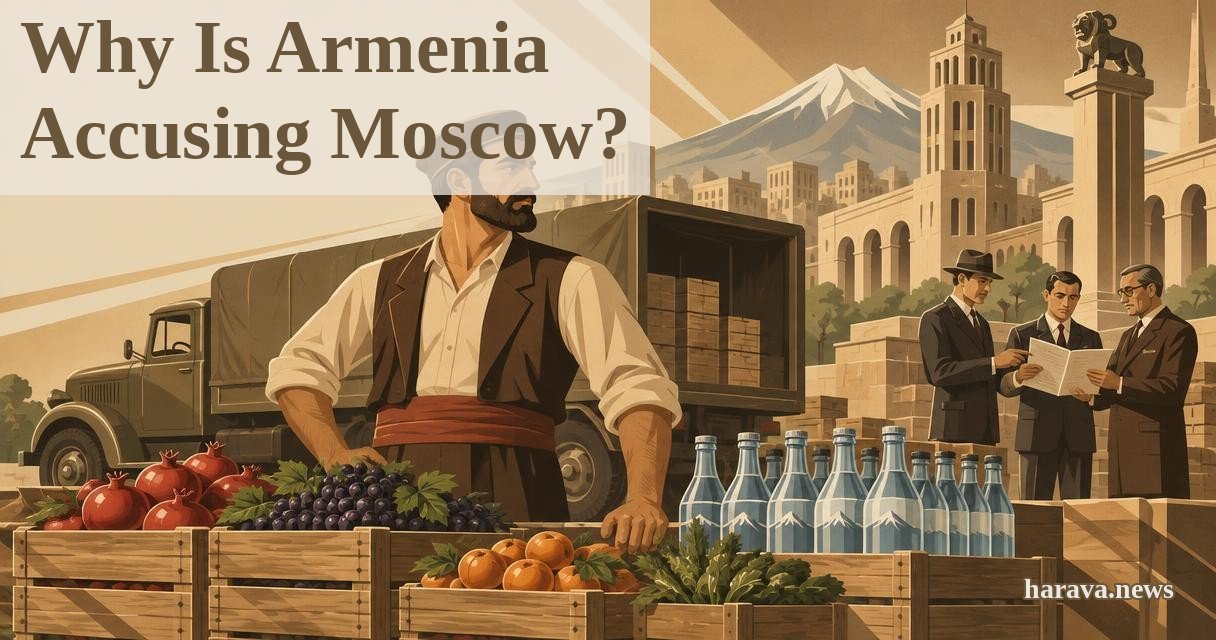
Since spring 2026, Russian agencies have restricted imports of more Armenian goods, including mineral water, flowers, alcoholic drinks, produce, fish and dairy products. Russian regulators cite safety and traceability concerns. Armenia says the restrictions violate EAEU rules. Their timing, before June’s parliamentary election and during the campaign, has led observers to see them as possible pressure, but timing alone does not prove political intent.
The four EAEU members say Armenia’s EU course conflicts with its obligations and propose jointly suspending treaty arrangements until a referendum on the country’s direction. The treaty does not set out a process for expelling or unilaterally suspending a member, so the report is a proposal, not an expulsion. It warns of a possible economic contraction of more than 15 percent; Armenia’s economy minister called that scenario exaggerated. The report says EAEU trade made up 37.8 percent of Armenia’s total trade in 2025, while Armenia accounted for less than one percent of each other member’s trade.
Exporters look for new buyers
Farmers and smaller firms that depended on Russian buyers face immediate losses. Farmers interviewed by JAMnews described selling produce locally at little or no profit. The government offered exporters an additional 4.5 billion drams in late September, while firms seek other buyers.
The EU adopted temporary tariff liberalisation covering around 80 percent of Armenian exports to the bloc for two years, subject to safeguards. It offers another route, but does not quickly replace established Russian customers or remove the costs of finding new markets.
What happens next
Analysts have read the pre-election restrictions as a way to make voters and officials feel the costs of Armenia’s shift toward Europe. Russia says the restrictions respond to regulatory non-compliance and concerns about incompatible EU and EAEU rules. Pashinyan’s accusation highlights the sovereignty stakes, but does not prove who ordered the restrictions or why. His government is seeking to diversify, not claiming it can quickly end economic ties with Russia.
Armenia has asked the Eurasian Economic Commission to recognise the restrictions as trade barriers; its review is expected to take 60–90 days. The four countries’ report is headed to the EAEU leaders’ next summit in December, and Pashinyan and Russian President Vladimir Putin are expected to speak before then. Neither an expulsion nor a clean break is settled. Armenia’s challenge is to diversify while keeping access to the Russian market and energy supplies it still depends on.