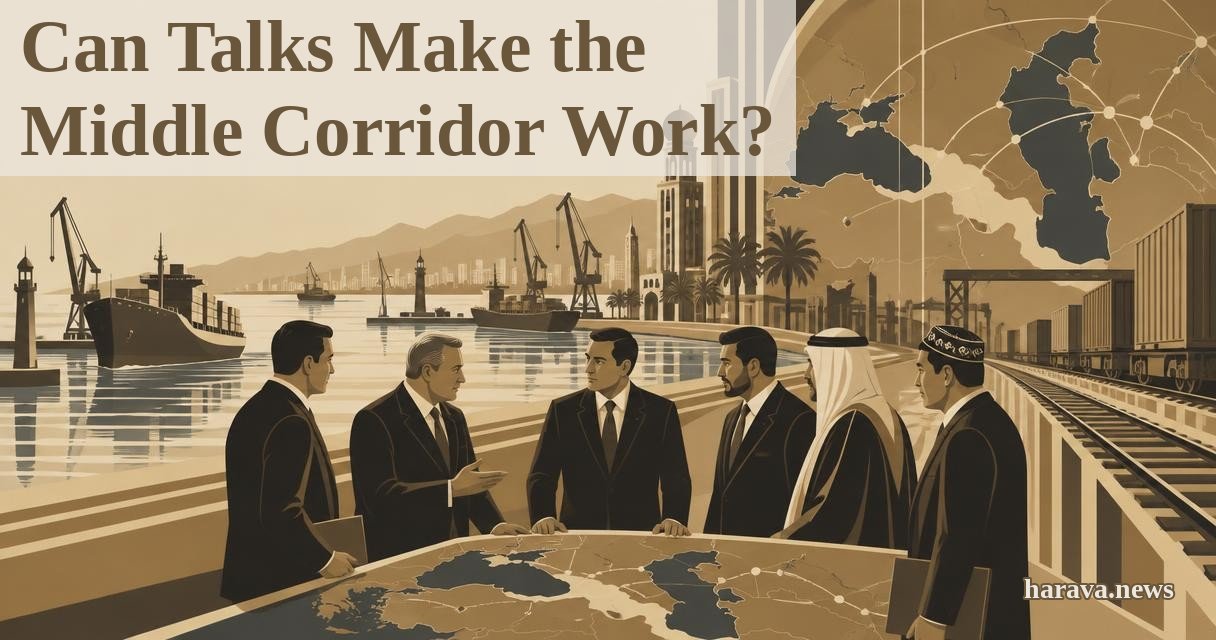
Georgia and five Central Asian states opened a new diplomatic channel at their first joint foreign-minister meeting to improve transport and trade links along the Middle Corridor.
What the ministers discussed
At the meeting in Batumi on October 23, Georgia, Kazakhstan, Kyrgyzstan, Tajikistan, Turkmenistan and Uzbekistan discussed transport, trade and economic cooperation, with the Middle Corridor as the main focus. They considered modernising infrastructure, using digital systems for freight and simplifying transit procedures. Turkmenistan proposed closer work with international transport bodies and a fibre-optic cable across the Caspian–Black Sea corridor. The ministers also visited Batumi’s port.
The Middle Corridor is a chain of railways, ports and ships. Its main east–west route carries cargo across Kazakhstan to the Caspian Sea, by ship to Azerbaijan, then through Georgia toward Türkiye and European markets. It bypasses Russia and offers another option alongside northern routes. The six-country format matters because Central Asian states need links to the main route, even though every shipment does not pass through all five of them.
The route predates the meeting. Kazakhstan, Azerbaijan and Georgia established a coordination mechanism in 2013–14, followed by a corridor association in 2017. Russia’s full-scale invasion of Ukraine in 2022 increased interest in routes that avoid Russian territory. The corridor is both a trade project and a way for landlocked Central Asian states to rely on a wider range of routes to global markets.
Demand brings both promise and caution
Kazakhstan’s official figures cited by The Astana Times put Middle Corridor freight at 4.5 million tonnes in 2024 and 4.1 million in 2025. Container traffic moved in the other direction, rising 36% in 2025 to 77,000 twenty-foot equivalent units. The increase may point to more use for higher-value cargo, but the freight decline is a reminder that growth is not guaranteed.
Georgia can attract port, rail and logistics business as the route’s South Caucasus link to the Black Sea. Reliable access through Georgia could give Central Asian exporters another way to reach international markets. For Kyrgyzstan, Tajikistan and Uzbekistan especially, the benefits depend on connecting services that avoid costly delays. The World Bank identifies wider market access and more jobs as potential gains, not automatic results of the meeting.
The route needs more than investment
Cargo must switch between trains and ships, cross borders and follow different procedures. A delay at a port or customs post can undermine improvements elsewhere. The World Bank’s September 2026 assessment estimates that more than $25 billion in physical investment is needed through 2040, mainly for rail, ports and maritime links, plus about $30 billion for supporting roads, rail connections and logistics facilities.
The bank says investment combined with efficiency reforms could more than triple route volumes and halve travel times by 2040. With stronger reforms, its scenario points to fourfold volumes and travel times cut by two-thirds. These are conditional projections, not promises. The bank also calls for a shared digital system for trade and transport data, closer coordination to address bottlenecks and better links between rail and shipping services.
In 2024, the European Commission reported a combined €10 billion commitment from international partners for sustainable transport connectivity in Central Asia. This was an aggregate of ongoing and planned investments, not a single fund for the full corridor or a guarantee that each priority project will be financed.
The next test is practical progress
The ministers described the new format as a basis for regular dialogue, and published accounts point to proposals and shared priorities. They did not announce a joint financing package, binding construction timetable or detailed implementation plan. Progress will depend on whether officials and transport operators agree on practical steps, such as shared data, predictable transit procedures and coordinated port and rail services, and identify who will pay. If not, the corridor may remain useful but difficult. If they do, it can give Central Asian traders and global shippers a more reliable choice, rather than replace every other route.