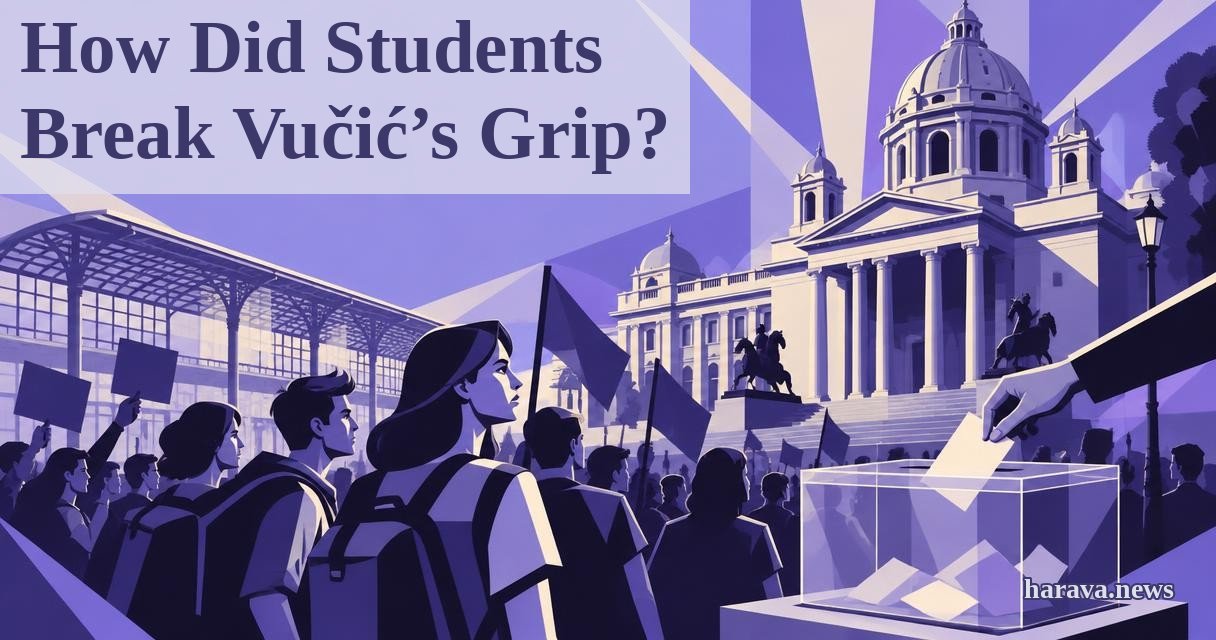
Serbia’s student-backed Student List is projected to win a parliamentary majority after nearly two years of protests, while Aleksandar Vučić conceded defeat.
From tragedy to a movement
The movement began after a concrete canopy at the railway station in Novi Sad collapsed on 1 November 2024, killing 16 people. The disaster raised questions about how recently renovated public infrastructure could fail and who would be held responsible. Students began with vigils and demands for accountability, while protests grew amid wider concerns about corruption, weak oversight and impunity.
Students organized campus blockades and open assemblies, called plenums, where people debated and voted on tactics. This decentralized structure helped the protests spread without a single leader or established opposition party. Farmers, lawyers, artists and others joined, including at a massive Belgrade rally in March 2025. For the election, the movement offered a list of 250 candidates, including academics, doctors, lawyers, actors and farmers.
A gamble and a partial count
Aleksandar Vučić’s Serbian Progressive Party has been in government since 2012, and he has been Serbia’s central political figure since 2014. In September, he called an early parliamentary election, although the next regular vote was not due until 2027. He resigned as president and campaigned for prime minister. Analysts saw the early election as an attempt to manage a growing crisis on a timetable they believed might favor the ruling camp. Instead, it gave the protest movement the contest it had long demanded.
Vučić conceded defeat on Sunday, 25 October, citing his own sample of results. Separately, Serbia’s election commission reported a partial count on Monday: the Student List had 52.54 percent and the Vučić-backed list 39.29 percent, with 8,077 of 8,392 polling stations processed. Turnout was 68.78 percent, its highest in more than three decades. Seat estimates put the Student List at roughly 138 to 140 of 250 seats; 126 are needed for a majority. The count was incomplete, but the projections indicated it could govern without a coalition partner.
A victory with challenges
The projected result does not mean observers considered the campaign fair. The OSCE’s preliminary assessment said ruling-party advantages, including misuse of state resources, and reports of pressure on voters, candidates and civil society compromised equal campaign opportunities. Election-day observers also reported intimidation and problems with ballot secrecy. These concerns are separate from the count, which showed the Student List comfortably ahead.
The Student List says it wants to fight corruption and organized crime, improve education and living standards, and strengthen media freedom and institutional independence. Governing will require decisions on laws, budgets, appointments and investigations. Its candidates have limited experience in national government, and the decentralized movement must choose a prime minister and keep a working majority united. Replacing the ruling party is one step; changing how institutions behave is harder.
What comes next
Foreign policy could test the movement’s unity. Student List candidates have said Kosovo remains part of Serbia and raised the possibility of a referendum on EU membership. Serbia’s path to EU membership has stalled amid disputes over democratic reforms and relations with Kosovo. The movement has not promised to join EU sanctions against Russia. These positions could complicate efforts to improve ties with Brussels, a major trade partner.
The election commission must complete the count, and the new parliament must form a government. Serbia’s electoral rules give the assembly 90 days from its constitution to elect one. The Student List has not named a prime minister. The vote has broken Vučić’s parliamentary dominance, but whether it reduces his broader influence will depend on what the new majority does with power.