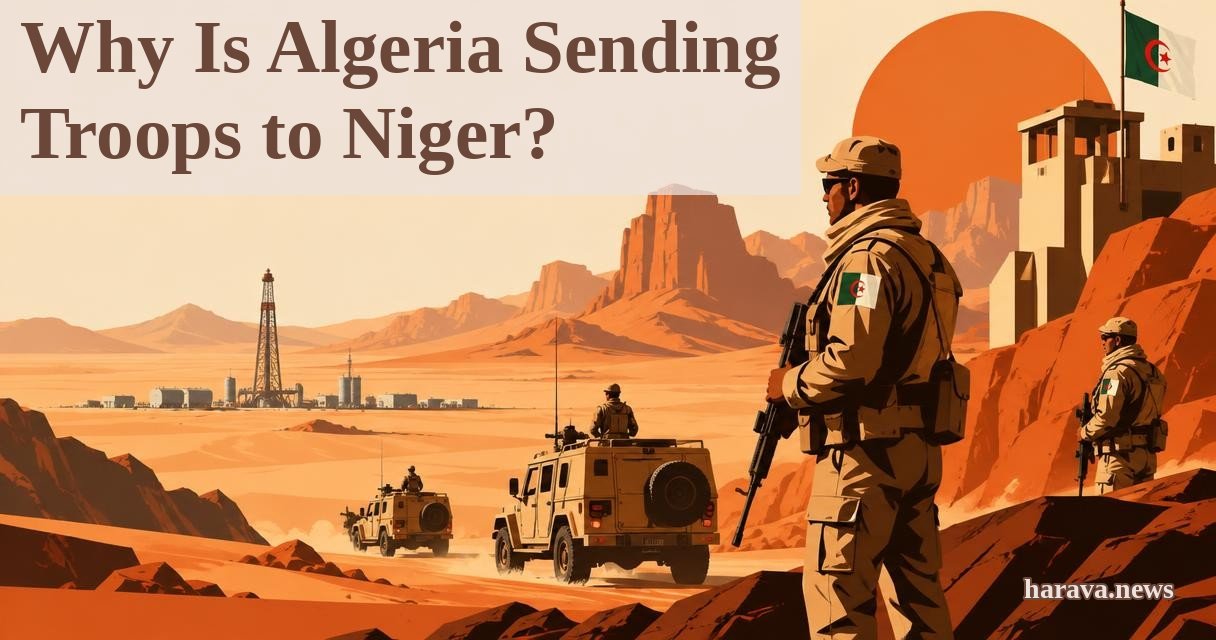
Algeria’s parliament approved a ground-force mission to Niger, the country’s first overseas ground deployment since 1973.
What the approval allows
The vote on October 25 completed a step required by Algeria’s constitution. President Abdelmadjid Tebboune approved the deployment the next day, after Niger requested military help. The stated purpose is to protect shared economic and energy interests.
The reported destination is Madama, in northern Niger near the Libyan border, at a former French military post. Officials have not disclosed the force’s size, arrival date or precise mission. Reuters reported that no troops had officially arrived at Madama when it reported the vote. Algeria had already sent aircraft to Niger in August, so the new step is the authorization of ground forces.
The energy interests at stake
Algeria’s state energy company Sonatrach has interests in Niger’s Kafra area. Its subsidiary ENAFOR began drilling an exploration well there in August to assess the oil-bearing ground and whether development could be commercially viable.
Algeria, Niger and Nigeria are also advancing the proposed Trans-Saharan Gas Pipeline, which is intended to carry Nigerian gas through Niger to Algeria and export links to Europe. Sonatrach began construction work on the Algerian segment in June, but the cross-border project remains a long-term undertaking. The exact relationship between Madama, the oil exploration and any future pipeline route is unclear.
Security ties are growing
Niger faces persistent attacks by armed groups, including near its northern frontier. A failed mutiny in Niamey in August also exposed a separate threat to the military government’s stability. Algeria sent fighter jets and support aircraft after Niger’s request. The ground-force authorization followed a visit by Niger’s defence minister and a newly signed military-cooperation protocol, whose terms have not been disclosed.
Relations had been difficult since Algeria condemned Niger’s 2023 coup. Tensions worsened after Algeria shot down a Malian drone near the border in 2025, prompting Niger, Mali and Burkina Faso to recall their ambassadors from Algiers. Relations improved this year, including through visits by Niger’s president and defence minister. Niger shares a long desert border with Algeria, where instability, attacks and trafficking can threaten security.
The limits are still unknown
Algeria has long been reluctant to send forces abroad, reflecting its emphasis on sovereignty and non-intervention. A 2020 constitutional change created a route for overseas deployments, requiring approval by two-thirds of each parliamentary chamber. Senator Belkacem Boulghiti described the mission as protection, not a move to wage war.
An invited Algerian force could help Niger protect valuable projects and reinforce its northern security zone. For Algeria, it could reduce risks to its investments. But a mission framed around protecting Algerian interests could become contentious if its duties or presence expand, and neighboring governments may view it as a wider shift in regional power.
Niger’s chief of staff has visited Madama for talks with local commanders, but there is no public timetable or stated limit on the mission. The number of soldiers and whether they will guard sites, join patrols or take on wider security tasks remain unknown.