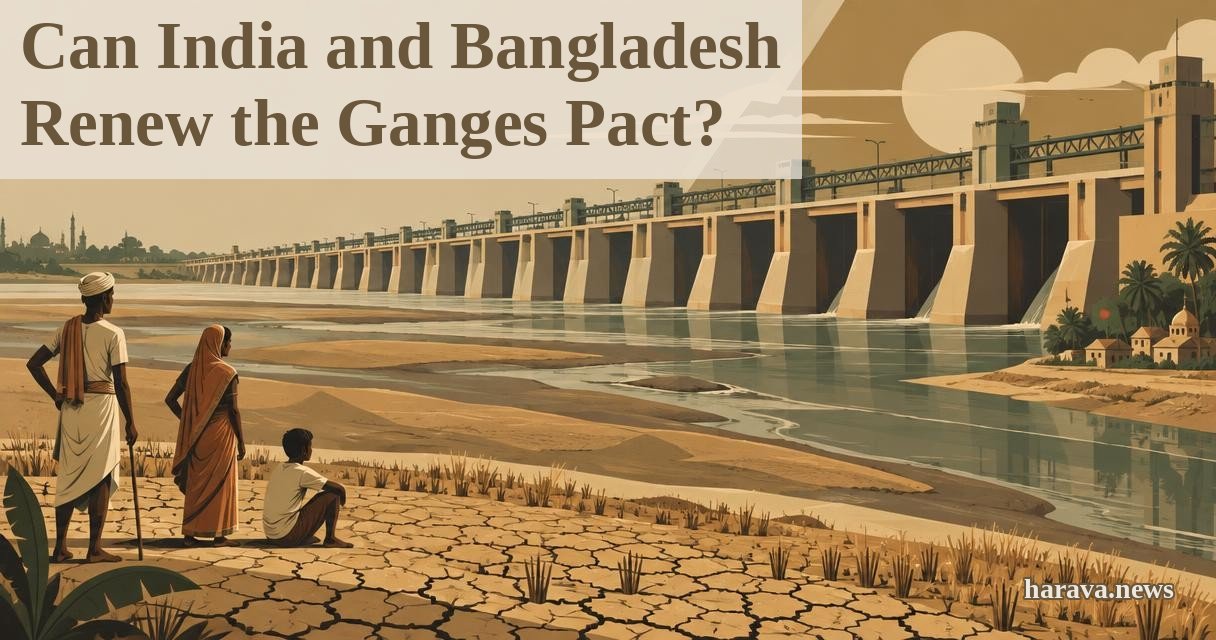
Bangladesh and India have six weeks to renew or replace the rules for dry-season Ganges flows before the 1996 treaty expires on December 12.
Talks remain uncertain
Dhaka says it asked India to open renewal talks but has received no response. India says river issues are handled through the Joint Rivers Commission (JRC), and technical treaty talks continued, most recently in May. A Bangladesh minister expressed hope for a deal earlier in October, but none has been announced.
The dispute predates the treaty. India built the Farakka Barrage in West Bengal to divert Ganges water toward the Hooghly River and support navigation to Kolkata’s port. Bangladesh said the diversion reduced dry-season flows. Temporary arrangements did not settle the issue, and the 1996 treaty created a standing water-sharing system for 30 years.
How the treaty shares water
From January 1 to May 31, the treaty divides water measured at Farakka in ten-day periods. At 70,000 cusecs or less, the countries split it equally. Between 70,000 and 75,000, Bangladesh receives 35,000. Above 75,000, India receives 40,000 and Bangladesh gets the rest.
The treaty’s reference schedule uses average flows from 1949 to 1988. It calls for emergency consultations if flow falls below 50,000 cusecs in a ten-day period and has no automatic renewal clause.
Why Bangladesh wants a guarantee
Bangladesh says the formula shares available water but does not ensure a dependable minimum when the river is especially low. The 1977 agreement had a clearer safeguard for Bangladesh’s share, and Dhaka wants a similar provision. The 1996 treaty offers a limited backstop: 90 percent of Bangladesh’s calculated share if the countries do not agree on adjustments after review.
A peer-reviewed study of 1997–2016 data found Bangladesh often did not receive its treaty share during critical dry periods. It said old flow projections and changing conditions weakened the arrangement.
The effects reach beyond diplomacy
In the Barind region, AFP spoke with residents who described dry stretches, ruined rice and wheat crops, and declining fish catches. One former fisher had switched to raising fish in ponds. Irrigation, fishing and navigation all depend on dry-season water.
Climate-driven shifts in rainfall and river flow make decades-old averages harder to rely on. Low flows can also worsen salinity and ecological stress in southwestern Bangladesh.
Pressure on both governments
India controls a key diversion point at Farakka, giving it the stronger physical position. But West Bengal’s interest in the Hooghly and Kolkata port, and demands from Bihar politicians—including members of the governing coalition—could limit India’s room to offer Dhaka a guaranteed flow. Bihar’s concerns include water for agriculture, drinking supplies and industry.
Bangladesh’s leverage is mainly diplomatic: a lasting agreement requires mutual consent, and failure could harm cooperation on other shared rivers. Expiry would not stop the Ganges, but it would remove the agreed allocation rules and consultation procedures. Strained relations since Sheikh Hasina fled to India in 2024, and the long-stalled Teesta water deal, add to the risk.
The next test is formal talks
The question is whether the JRC becomes a venue for formal renewal negotiations, not just technical contact. Dhaka wants a longer-term deal with a clearer water guarantee and provisions for climate and basin-wide needs. India says it is considering river issues through the JRC, while Bihar’s demands feature in its domestic debate. Reports have discussed a leaders’ meeting before the deadline, but it is not confirmed. The minister’s optimism is an expectation, not evidence that a deal is near.