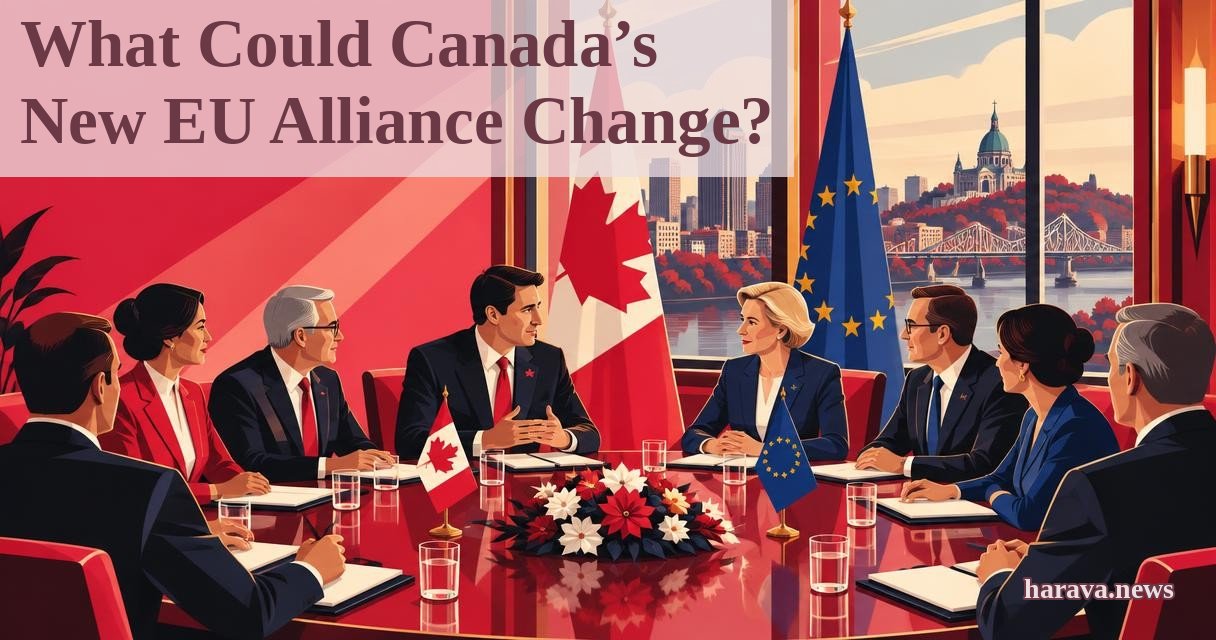
Canada and the European Union used a Montreal summit to set a broad framework for closer ties, but left the proposed associate relationship undefined.
Building on existing ties
The partnership builds on ties already in place. Canada and the EU signed their major trade deal, CETA, in 2016; it has applied provisionally since 2017 and removed tariffs on most goods. Nine EU countries still need to ratify it fully. In 2025, the sides signed a defence partnership, and Canada later became the first non-European country to join the EU’s SAFE defence procurement program.
The sides are seeking more options as trade tensions with the United States persist. President Donald Trump has threatened tariffs on Europe over the proposed Canada-EU relationship. Carney and EU leaders say closer ties can help them make independent choices, not serve as a move against Washington. Canada offers resources and a market beyond Europe’s borders; the EU offers Canadian firms more customers, investment and research links. Both want supply chains less exposed to disruption or pressure from a single powerful trading partner.
Practical steps, with more work ahead
The new “Alliance for the Future” is a political framework, not a promise of EU membership or a new shared market. It covers trade, technology, critical resources and energy, finance, security, and people-to-people ties. Negotiators concluded talks on digital trade and competition agreements. A new arrangement is intended to help the European Investment Bank invest in Canadian critical-resource projects, and Canadian researchers are joining the EU’s high-performance computing network. Not every goal has become a binding, active agreement.
EU officials say the digital trade agreement is designed to make cross-border data flows more predictable, simplify electronic contracts and signatures, and strengthen online consumer protections. It could make it easier for companies, especially smaller businesses, to sell digital services or goods across the Atlantic. But negotiations have concluded; the agreement still needs formal signature and approval. It would supplement CETA, not give Canadian firms unrestricted access to every part of the EU digital economy.
Associate status remains undefined
Making Canada the EU’s first “associate member” remains an idea to define, not a status Canada has secured. EU treaties do not establish an associate-member category. The joint statement instead commits the partners to define an “ever-closer association,” short of full membership, by their 2027 summit. EU officials have discussed closer alignment on climate, energy and AI, and wider participation in programs such as Horizon Europe and Erasmus+. None of these possibilities is a settled entitlement.
Germany and other governments objected to endorsing “associate membership” before its meaning and legal basis were clear, partly because the label could set a precedent. Any arrangement will need to specify Canada’s access, the rules it would follow and what participation might cost. The unresolved ratification of CETA shows that agreement among the partners does not guarantee a quick decision.
Carney says he expects negotiations on the new relationship to conclude by June 2027; the joint statement commits the partners to define the concept by the 2027 summit. A Canada-EU meeting involving the Canadian cabinet and the European Commission is planned for March. Digital-trade negotiators must still complete legal review, signature and approval. The test will be whether clear rules deliver dependable market access, shared research infrastructure and more secure sources of vital materials and technology, while settling questions of rights, costs and obligations.