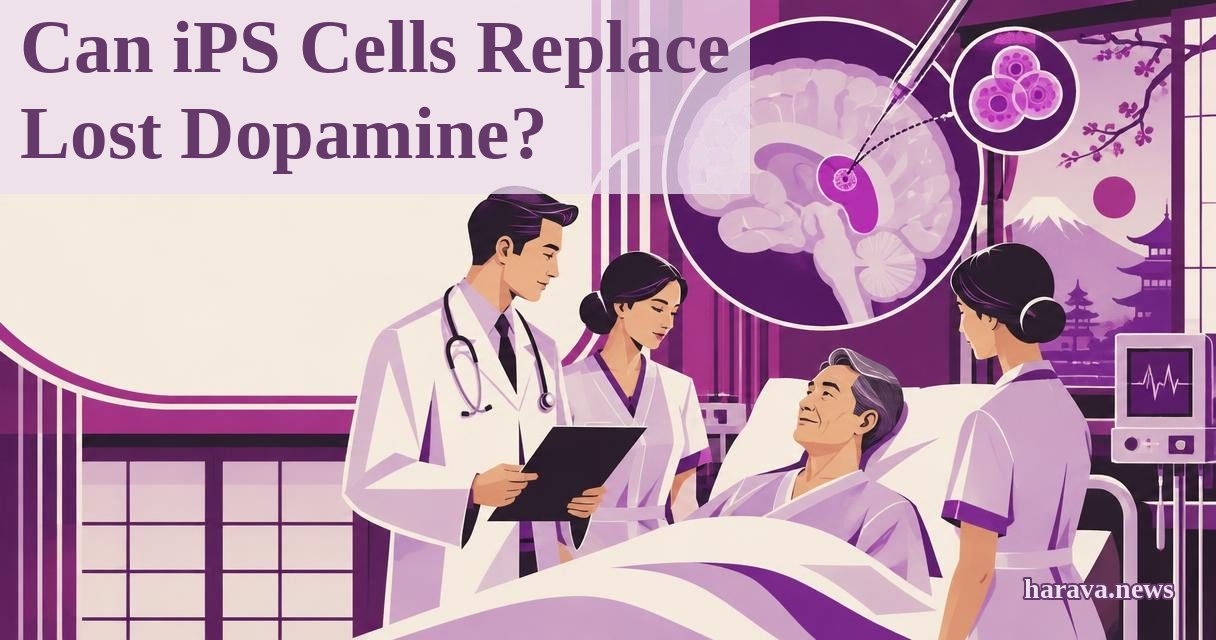
Japan has moved an iPS-cell treatment for Parkinson’s disease into monitored clinical use, after its first patient under conditional approval received a transplant at Kyoto University Hospital in October.
What the first transplant means
The patient was a woman in her 50s. Sumitomo Pharma said she had left hospital and returned to work. That reports her recovery from surgery, not that the graft eased her Parkinson’s symptoms.
Seven people had received the experimental transplant in Kyoto’s earlier trial. The October operation was the first after conditional marketing approval, moving the treatment from a small study to use in Japan’s health-care system.
How the cell treatment works
Parkinson’s progressively destroys dopamine-producing neurons, especially those that send signals to the putamen, a brain area involved in movement. Levodopa can ease symptoms by increasing dopamine, but it does not replace neurons. Some patients later have less reliable relief or involuntary movements. Fetal-tissue grafts offered early evidence that cell replacement might help, but supply, ethical concerns and complications made routine use difficult.
Amchepry, also called raguneprocel, uses induced pluripotent stem (iPS) cells. Researchers reprogram mature cells donated by another person, then guide them into precursors of dopamine-producing neurons. Surgeons implant these precursors, not undifferentiated iPS cells, into the putamen. Donor cells could supply several patients, but the recipient’s immune system may treat them as foreign; trial patients received tacrolimus to suppress immunity.
What the trial and approval show
Kyoto University’s 2025 Phase I/II trial enrolled seven patients aged 50 to 69, who were followed for 24 months. Researchers reported no serious adverse events and 73 mild or moderate events. MRI scans showed no graft overgrowth, while brain imaging indicated that the grafts produced dopamine. Of six patients assessed for movement, four improved on the score measured off medication, and five on the score measured while taking medication.
Japan approved Amchepry conditionally on March 6, 2026, to improve movement symptoms when medicines including levodopa do not work well enough. Under this pathway, safety is assessed and benefit reasonably predicted while evidence is gathered after approval; this is not proof from large studies. The approval lasts seven years and requires continued assessment. Regulators say use should be confined to institutions with Parkinson’s expertise and experience in surgery that precisely targets brain areas.
What researchers still need to learn
The next question is whether results hold in a larger, more varied group. Sumitomo plans roughly one or two treatments in fiscal 2026, about 10 in fiscal 2027 and 10 to 20 in fiscal 2028. The company has described a post-approval study collecting evidence from around 35 patients by about 2029. Researchers must track movement, medication needs, graft survival, immune reactions, abnormal growth and lasting benefit.
For patients whose symptoms remain poorly controlled, the therapy aims to replace cells involved in motor symptoms; it is not a proven cure and has not been shown to stop disease progression. Its listed price is about ¥55.3 million per procedure. Public insurance may make it accessible, but its benefits must be weighed against cost and surgical risks.