Xiaomi’s reported eight-hour factory run is an endurance test, but it does not prove humanoid robots can replace workers or cut production costs.
What the video shows
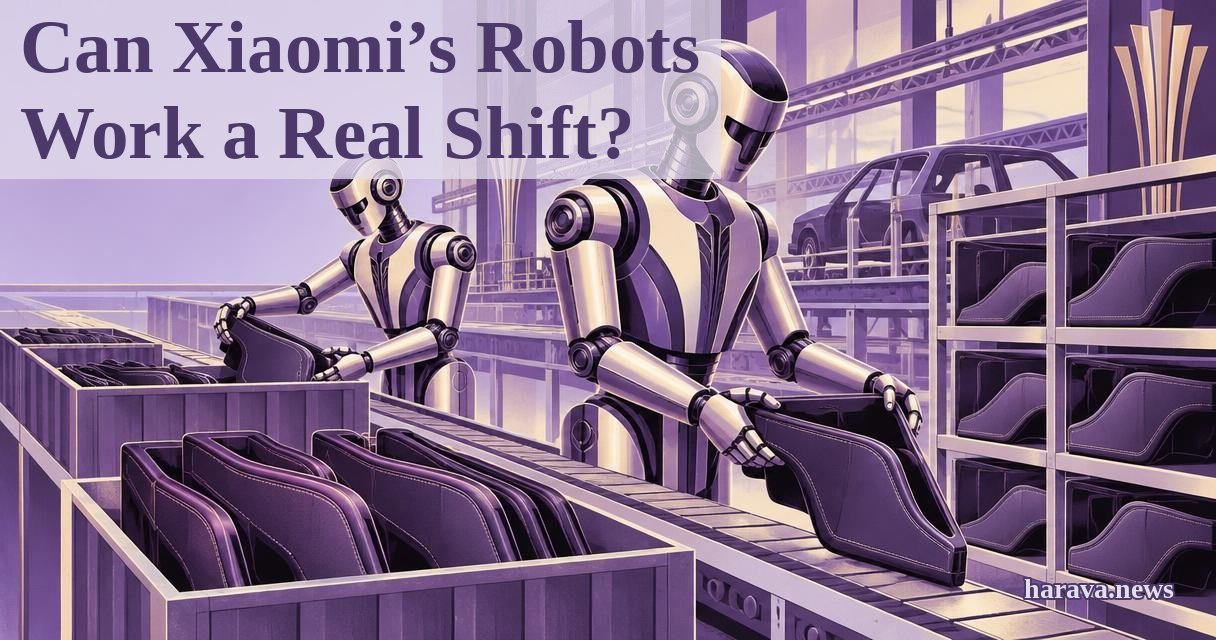
A November 3 video shows two humanoid robots sorting center-console side covers at Xiaomi’s car factory, moving parts from containers into racks. Xiaomi says they worked autonomously, corrected anomalies and coordinated with the production-line system. But the footage is sped up, and Xiaomi did not disclose how many parts they sorted, their sustained success rate or how often people intervened. The eight-hour duration shows how long the demonstration lasted, not how much useful work the robots did or how independent they were.
How the trials have changed
In March, Xiaomi reported that a humanoid robot installed self-tapping nuts for three hours, with a 90.2% success rate while meeting the station’s 76-second cycle requirement. In July, Xiaomi said success on that task had reached 98%, and reported 90% operational success on newer jobs, including sorting flexible side covers and folding storage boxes. These were different tests and stations, so they do not establish accuracy during the eight-hour run. They do show a move toward more varied handling and longer operation.
Why try a humanoid?
A human-shaped robot might work among existing benches, bins and racks without requiring a factory to be rebuilt. This could help with irregular or flexible parts. The International Federation of Robotics describes humanoid robots as an attempt to handle varied tasks in environments designed for people.
Adaptability is not proof of economic value. Analysts at McKinsey say reliable performance, uptime, safety and lower costs remain hurdles to large-scale deployment. A machine designed for one station may be a better fit if it can do that job faster and more cheaply.
A factory as a test ground
Xiaomi can test robots on real production work in its own plant as it pursues its stated aim of bringing them into factories at scale. In March, Xiaomi’s president called the robots “interns,” not established production workers, and said keeping up with the line was a central challenge. Founder Lei Jun later said the company expected large-scale factory deployment within five years. The factory is both a place to test automation and a proving ground for a broader robotics ambition.
What evidence is still needed
For factory managers, the key questions are the cost and reliability of each correctly sorted part: speed, downtime, charging needs and human help. Automation may change or remove repetitive tasks, but this demonstration alone offers no evidence that Xiaomi has cut jobs. The International Federation of Robotics says automation’s employment effects involve task substitution and changes in productivity and work, not simply one-for-one job replacement.
Xiaomi’s five-year ambition points toward broader factory use by around 2030, but it is a goal, not a rollout schedule for these robots. Useful next evidence would include repeat runs with published output, error rates, intervention records and operating costs, ideally across more than one task. Until then, the shift shows progress in endurance and factory integration, not proof that humanoids are ready to change factory labor costs.