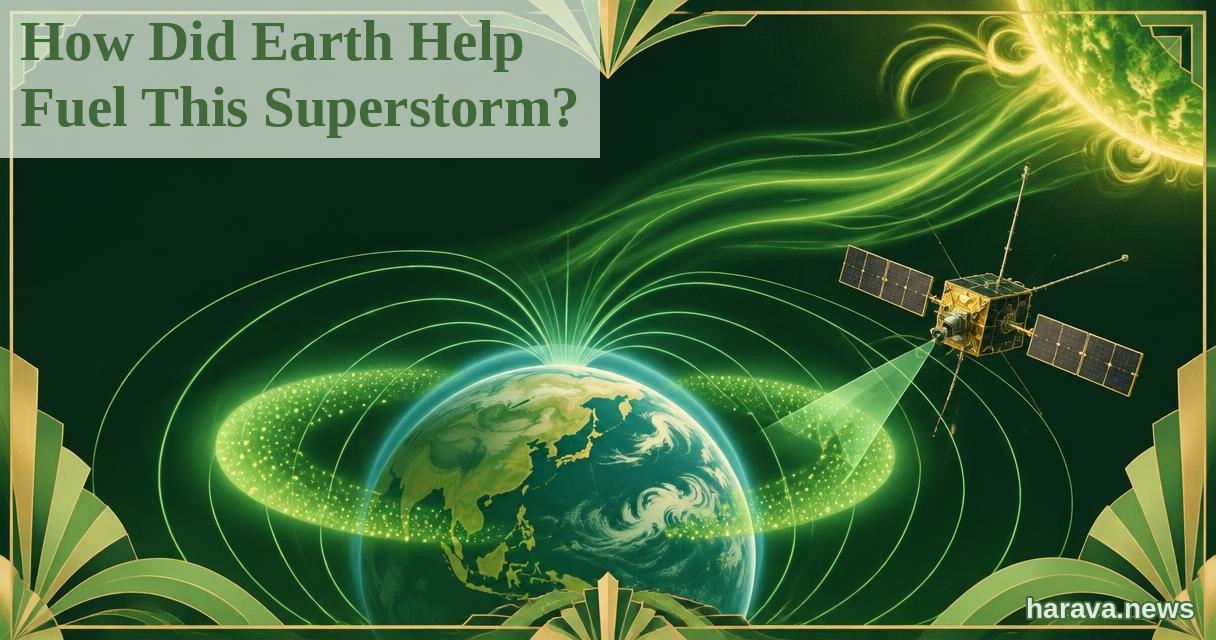
The May 2024 superstorm was triggered by solar eruptions, but Arase measurements show that Earth’s upper atmosphere supplied more than 85% of the energetic ions it measured in the storm’s ring current.
What Arase found
Multiple solar eruptions sent clouds of magnetized plasma toward Earth. The clouds merged on the way and struck the magnetosphere on May 10 and 11, producing a G5 storm. The SYM-H index fell to −518 nanotesla, the second-lowest value recorded since that measure began in 1981.
The ring current is a belt of charged particles trapped around Earth. Before this event, researchers had not directly measured it during a superstorm of this scale. Arase measured ions in the 9.6–184.2 keV energy range and found that more than 85% were from Earth, especially heavy ions such as oxygen. Solar-wind ions contributed little to the ring current’s energy density.
Earth supplied particles, not energy
The Sun remained the storm’s driver. The finding instead shows that Earth’s atmosphere supplied much of the material carrying the ring current. Solar input can disturb the magnetosphere and upper atmosphere, helping ions escape upward and move through near-Earth space. How they make that journey still needs investigation.
Researchers are advocating for FACTORS, a proposed Japanese two-satellite mission concept that would study how atmospheric ions enter the magnetosphere. It is not a launched or approved mission.
Why heavy ions may matter
Oxygen ions are much heavier than the most common solar-wind ions. Researchers report that the super-intense ring current reached unusually close to Earth, strongly distorted the local magnetic field and drove radiation-belt electrons outward, contributing to their loss from near-Earth space. They suggest Earth-origin heavy ions may have helped intensify the disturbance, but the measurements do not show that ion composition was its sole cause.
Extreme storms can threaten spacecraft, disrupt positioning and communications, and induce damaging currents in power systems. Better accounting for the ionosphere could help models estimate how a storm develops and where its effects will be strongest.
What scientists still need to test
Researchers need to compare this event with other storms, trace the ions’ routes and test how well models reproduce the observed current. This was one rare superstorm, not proof that Earth-origin ions dominate every extreme event. Forecasting solar outbursts may not be enough; scientists may also need to understand how Earth’s upper atmosphere responds.