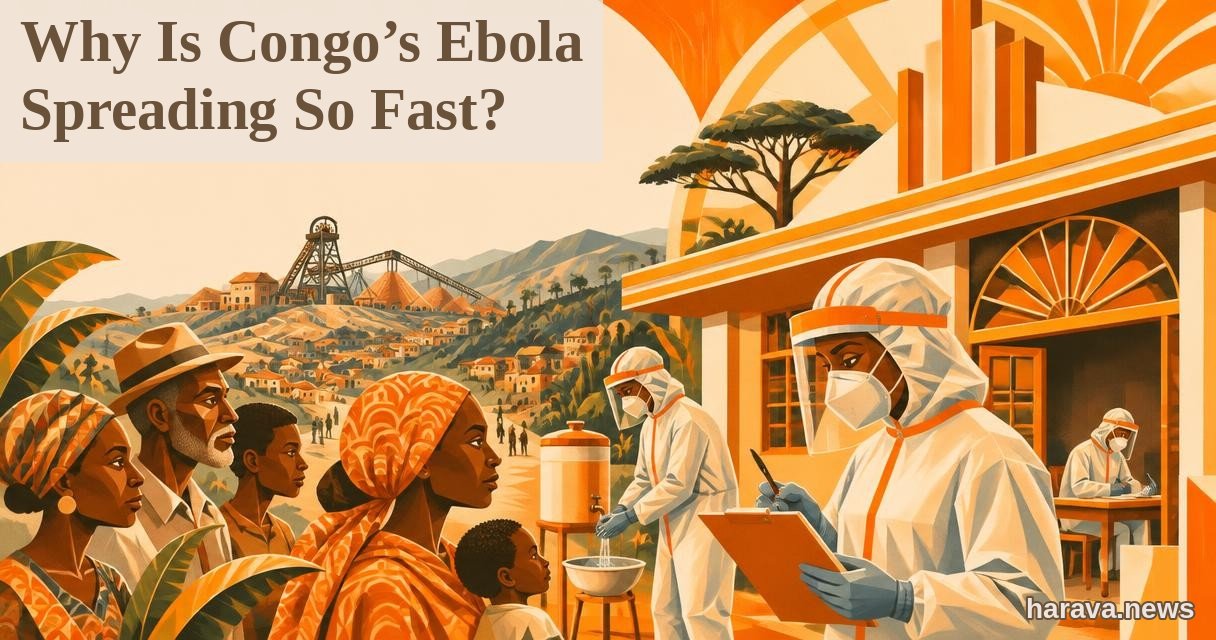
Six months after the Democratic Republic of Congo declared an Ebola outbreak in Ituri province, cases keep rising as violence, delayed detection and gaps in basic health services disrupt containment.
A rapid rise in cases
By Nov. 14, the outbreak had reached 11,376 confirmed cases and 5,568 related deaths across eight Congolese provinces, according to the European Centre for Disease Prevention and Control. It is the largest Ebola outbreak recorded in Congo and the second largest globally, behind West Africa’s 2014–16 epidemic. The U.S. Centers for Disease Control and Prevention says Congo’s outbreak passed 1,000 confirmed cases within 40 days of response activation; the 2018–20 outbreak took about 235 days to reach that mark.
How the outbreak began
Early warning signs were difficult to interpret. On May 5, the World Health Organization was alerted to an unexplained illness killing people, including health workers, in Mongbwalu, a busy mining area. The first currently known suspected case developed symptoms in late April, and laboratory testing confirmed Bundibugyo virus in mid-May. WHO said the outbreak was thought to have begun in Mongbwalu, but investigations into its origin were continuing. People also traveled between the area and nearby towns to seek care, giving the virus opportunities to spread.
Why detection is difficult
This is not the Ebola strain behind the West African epidemic. Bundibugyo virus spreads through direct contact with an infected person’s bodily fluids or contaminated materials, including during unsafe burials and in health facilities without strong infection controls. Early symptoms such as fever and fatigue can resemble malaria, making prompt recognition harder.
There is no licensed vaccine or specific treatment for Bundibugyo disease. Responders rely on testing, isolation, supportive care, contact tracing, safe burials and community cooperation. Available reporting points to failures in detection and response, not a demonstrated change in the virus itself.
Insecurity disrupts contact tracing
WHO Director-General Tedros Adhanom Ghebreyesus said attacks on health workers and facilities had restricted access. After a deadly attack in Cantine-Aloya, more than 1,000 contacts were lost to follow-up and three confirmed cases could not be located. Médecins Sans Frontières says only 9% of Ebola patients treated by its teams in Ituri had previously been identified on contact-tracing lists. When teams cannot safely reach communities, they may miss cases until people are seriously ill and lose the chance to monitor their contacts.
Shortages weaken the response
Reuters reported that less than half of the $2.9 billion pledged for the response had been disbursed, according to Africa CDC. MSF describes unpaid or striking staff, ambulances without fuel, community workers without phones or mobile data, and clinics lacking supplies. These gaps weaken surveillance, delay care and can expose people in health facilities. Health workers’ pay and safety affect the whole response.
The risks reach beyond Congo
People in affected communities and the health workers caring for them face the most immediate risks. Cases have also been reported outside Congo, though authorities have contained outbreaks in some countries. The CDC says no U.S. cases have been linked to this outbreak and that risk to the American public remains low. Continued spread in Congo could lead to more cross-border cases.
What could improve containment
The response depends on getting staff, supplies and surveillance teams into affected areas, paying and protecting frontline workers, and rebuilding community trust. Research on vaccines and treatments is progressing, but cannot replace those measures. Two Bundibugyo-specific vaccine candidates have been recommended for a clinical trial, with results expected in early 2027. Progress will depend on whether responders can find cases earlier, trace contacts and make care safer and easier to reach.