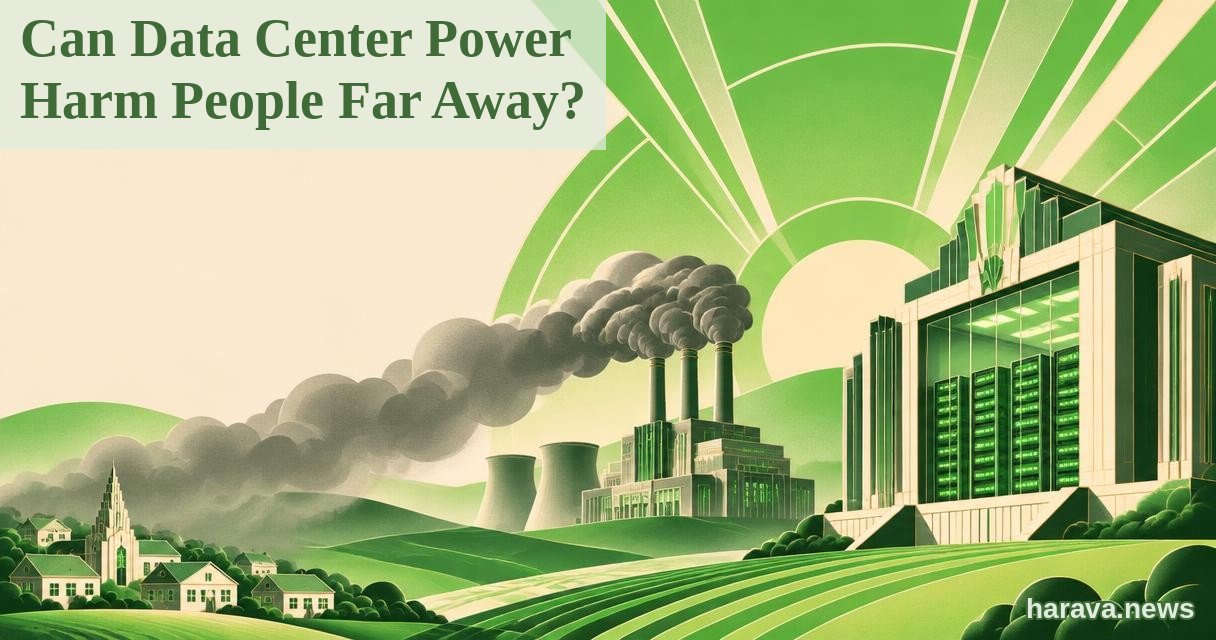
An MIT-led model estimates that U.S. data-center electricity demand contributed to about 650 premature deaths from air pollution in 2023, many far from the facilities.
How power demand travels
Data centers use power where they are built, but the power plants serving them may be elsewhere, and pollution can travel farther still. Lawrence Berkeley National Laboratory estimated that U.S. data centers used 176 terawatt-hours of electricity in 2023, or 4.4% of the country’s total. AI has helped drive rapid growth in demand. Rather than assign data centers an average share of grid pollution, researchers modeled which plants increased generation hour by hour when that demand was added, then modeled the effects on air quality.
Where the model found the harm
The modeled demand was largest in Virginia and Texas, but some of the highest estimated death rates per person were in the Midwest. The researchers point to coal-fired plants supplying extra electricity in parts of the region. Their emissions can form fine particles downwind, with help from local atmospheric chemistry. Nitrogen oxides can also contribute to ground-level ozone, whose effects vary by season.
The researchers estimate that fine particles were linked to 513 premature deaths and ozone to 137. These are modeled estimates for populations, not death certificates tied to data centers.
What the estimate leaves out
The reported range is 559 to 740 deaths. It reflects uncertainty in the health-risk relationships used, but not uncertainty in the emissions and air-quality models. Those models represent pollution at roughly 50-kilometer resolution and may miss local exposure patterns. The study assumes data centers run continuously on grid power and excludes emissions from on-site backup generators. The authors say that omission may understate pollution close to facilities. The estimate covers one important pathway—pollution from grid electricity—not the full environmental footprint of data centers.
Who bears the pollution
In the model, nonurban populations had higher estimated death rates per person than urban populations. The broader question is who benefits from computing and who bears the pollution produced to power it.
The researchers argue that air quality should be considered in data-center siting and grid planning. They also say it could be worth studying whether computing demand can shift to different times. This is a call for further analysis, not a new rule.
Grid rules are still being reviewed
Grid rules are already under review, though not specifically because of this study. In June, the Federal Energy Regulatory Commission directed six regional grid operators to justify or reform how large users connect, citing the need to add new loads while protecting reliability and consumers. Most operators filed proposals in November. Some would let large users accept power cuts under certain conditions; others address who pays for grid upgrades or how new loads secure generation. The proposals remain subject to FERC review, and many changes would take years to implement. The MIT findings add a health question to the debate: where the electricity is generated and who breathes the resulting pollution.