Google Research’s November 25 release presents six mathematical papers generated by its Cogentic AI system, but their boldest claims remain proposals until outsiders check the proofs.
Six papers tackle different problems
The papers cover integer factoring, discrete logarithms in finite fields, approximate solutions to two-player games, communication complexity and graph reconstruction. One paper offers a second, deterministic approach to factoring.
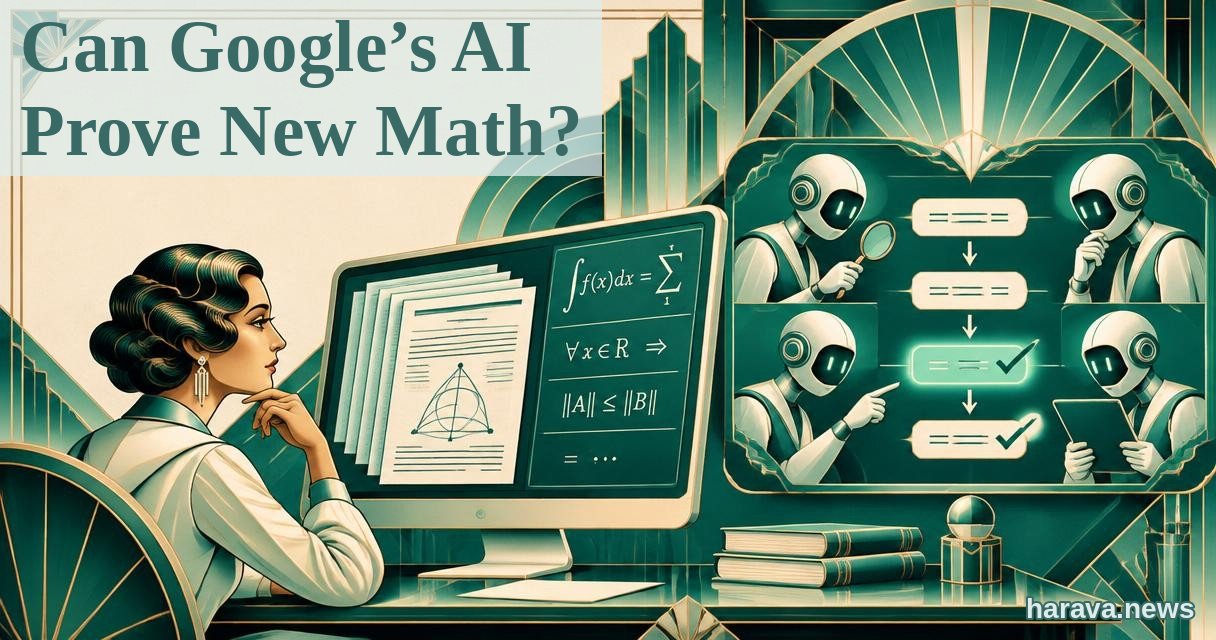
Cogentic sends independent AI “provers” down different paths, uses specialized agents to challenge proposed steps and saves results that pass those checks. The system’s introductory paper says domain experts independently checked earlier results. For this new batch, Google says Cogentic generated the work from an initial prompt without further human involvement.
What the factoring claim says
One paper claims a rigorous factoring algorithm with expected running time L_N[1/3,105], without relying on unproven number-theory assumptions. In 1992, Lenstra and Pomerance proved a rigorous bound of L_N[1/2,1+o(1)]. The new exponent matches the form associated with the faster number field sieve, whose performance analysis is heuristic.
The constant 105 matters, and a better asymptotic guarantee does not prove a faster practical attack. The paper does not show that the method can break deployed RSA keys in realistic conditions. Its separate deterministic factoring paper makes a different claim.
Why independent checks matter
Factoring is central to RSA, while discrete logarithms underpin other public-key systems. But the discrete-log paper concerns finite fields of fixed characteristic, not every cryptographic group. Even if the claims hold, they would not by themselves mean today’s encryption is suddenly broken.
The paper descriptions say complete Lean 4 formalizations exist and will appear in a companion submission, but they were not publicly available with the papers at release. Lean can check formal proofs once researchers can run the code. Reviewers must also check that the formal statements match the claims and that the running-time analyses mean what the authors say.
The claims await review
The larger question is whether systems like Cogentic can find useful ideas faster than people can verify them. If the results survive scrutiny, AI will have moved further from assisting research to producing candidate research. If flaws emerge, the episode will show how quickly machine-generated papers can create a verification burden.