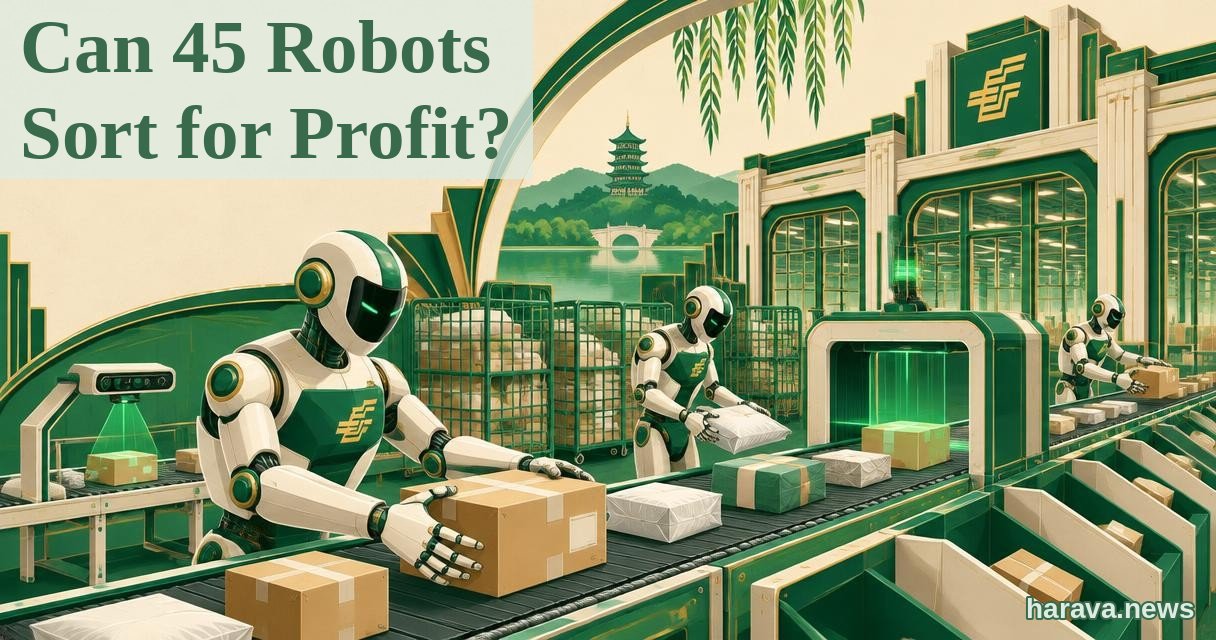
Robotera’s 45 humanoid robots at China Post’s Hangzhou hub are a real-world test, but public figures do not yet show whether they are reliably faster or cheaper than staffing the work.
Why the trial matters
China handled 198.95 billion express parcels in 2025, up 13.6% from the year before. At sorting hubs, machines can move parcels on belts and scan them, but feeding a line means picking up mixed items, turning and identifying them, then placing them for automated handling.
Robotera says its robots do this work, including identifying and rejecting irregularly shaped parcels. They work alongside existing sorters, scanners and automated guided vehicles, rather than replacing the whole sorting system.
What the robots and reports say
Robotera describes the M7 as a fixed, half-body humanoid with a torso, arms and dexterous hands. The trial tests whether it can handle varied parcels at a station designed for human work, not whether a walking robot can do every warehouse job. Robotera says the Hangzhou setup needs no production-line refit, but has not explained in detail how the machines are integrated or supervised.
In a November 26 release, Robotera said testing began in April. It reported an early rate of 500–600 parcels an hour, rising to about 1,200 during specific test periods, with operational accuracy above 90%. Global Times, citing the company’s WeChat post, says the 45-robot pilot started in early September, gives a designed capacity of 1,200 parcels per hour “per unit,” and reports on-site throughput later topped 1,500 per hour.
The figures leave questions
The dates could describe different testing stages, but the reports do not explain this. They also do not consistently say whether the rates are for one robot, one work cell or the full fleet. The 1,500 figure is not confirmed as a sustained rate for all 45 robots.
Buyers would need to know how often the robots stop, how many parcels need human help, how they handle peak shifts and how much labor they save after maintenance and supervision. There is no public breakdown of these measures or the M7’s purchase and operating costs. Reuters reported an industry estimate that an industrial humanoid would need to cost about 160,000 yuan, including maintenance, to pay back within two years against a worker earning 80,000 yuan a year. Typical humanoid costs were estimated at 300,000–500,000 yuan; these are industry benchmarks, not an M7 price.
What would support wider use
China Post presents the robots as extra capacity for repetitive, strenuous work and demand peaks. Robotera says repeated optimization has improved performance and that its robots are deployed at 11 China Post hubs in eight Guangdong cities. The company says workers can move toward maintenance, coordination and quality control, but has published no staffing figures to show how this is working.
Robotera says China Post’s Hangzhou branch plans to extend automation, including sorting and security-inspection equipment, into more operations. It has not promised to repeat the 45-robot setup elsewhere. Wider adoption will depend on reliable results across shifts, handling varied parcels and a credible cost comparison.